Identifying Narcolepsy Symptoms Is Important
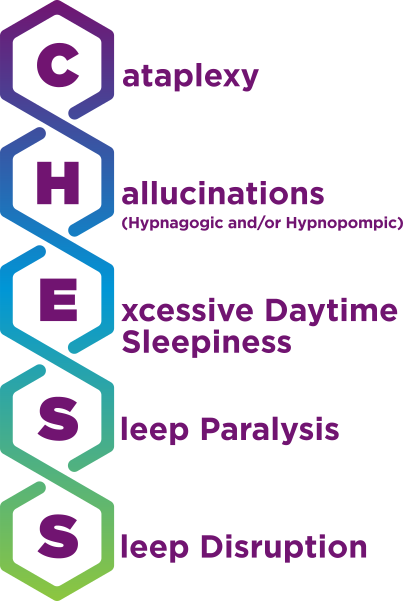
There are 5 main symptoms of narcolepsy, referred to by the acronym CHESS (Cataplexy, Hallucinations, Excessive daytime sleepiness, Sleep paralysis, Sleep disruption).1 While all patients with narcolepsy experience excessive daytime sleepiness, they may not experience all 5 symptoms.2,3 Looking deeper for these symptoms during the clinical interview may help identify patients with narcolepsy.2,4
The 5 Main Symptoms of Narcolepsy
The burden of narcolepsy goes
beyond symptoms5-8 Explore comorbidities
Cataplexy
Estimated to be present in 65%-75% of patients with narcolepsy9
This most specific symptom of narcolepsy type 1, is the sudden, generally brief (<2 minutes) loss of muscle tone with retained consciousness. It is usually triggered by strong emotions, such as laughter, surprise, or anger.2,3,10
Hallucinations (hypnagogic and/or hypnopompic)
May affect 33%-80% of patients with narcolepsy11
Hypnagogic hallucinations are vivid dreamlike experiences that occur while falling asleep. When they happen while waking up, they are called hypnopompic hallucinations.2,3 These events may occur with sleep paralysis.3
Excessive daytime sleepiness
Affects 100% of patients with narcolepsy9,11,12
Excessive daytime sleepiness is the inability to stay awake and alert during the day, resulting in periods of an irrepressible need for sleep or unintended lapses into drowsiness or sleep.2,3 Excessive daytime sleepiness is the cardinal symptom of narcolepsy and often the most disabling.2
Sleep paralysis
May affect 25%-50% of patients with narcolepsy11
Sleep paralysis is the disturbing, temporary inability to move voluntary muscles or speak during sleep-wake transitions. It is often accompanied by hypnagogic or hypnopompic hallucinations.1-3,13
Sleep disruption
Estimated to affect 30%-95% of patients with narcolepsy11
Sleep disruption (also known as disrupted nighttime sleep) is due to frequent awakenings, resulting in poor quality sleep.2,3,11 Because narcolepsy is a disorder of sleep-wake state instability,14,15 many patients commonly report disruption of nighttime sleep.2,11
- Pelayo R, Lopes MC. Narcolepsy. In: Lee-Chiong TL, ed.Sleep: A Comprehensive Handbook.Hoboken, NJ: Wiley and Sons, Inc.; 2006:145-149.
- American Academy of Sleep Medicine. Central disorders of hypersomnolence. In: The International Classification of Sleep Disorders – Third Edition (ICSD-3) Online Version.Darien, IL: American Academy of Sleep Medicine; 2014.
- Ahmed I, Thorpy M. Clinical features, diagnosis and treatment of narcolepsy. Clin Chest Med.2010;31(2):371-381.
- Thorpy MJ, Krieger AC. Delayed diagnosis of narcolepsy: characterization and impact. Sleep Med.2014;15(5):502-507.
- Black J, Reaven NL, Funk SE, et al. Medical comorbidity in narcolepsy: findings from the Burden of Narcolepsy Disease (BOND) study.Sleep Med. 2017;33:13-18.
- Ohayon MM. Narcolepsy is complicated by high medical and psychiatric comorbidities: a comparison with the general population.Sleep Med. 2013;14(6):488-492.
- Jennum P, Ibsen R, Knudsen S, Kjellberg J. Comorbidity and mortality of narcolepsy: a controlled retro- and prospective national study.Sleep. 2013;36(6):835-840.
- Cohen A, Mandrekar J, St Louis EK, Silber MH, Kotagal S. Comorbidities in a community sample of narcolepsy.Sleep Med. 2018;43:14-18.
- Cheung J, Ruoff CM. Central nervous system hypersomnias. In:Sleep and Neurologic Disease.2017
- Overeem S, van Nues SJ, van der Zande WL, et al. The clinical features of cataplexy: a questionnaire study in narcolepsy patients with and without hypocretin-1 deficiency. Sleep Med.2011;12(1):283-290.
- Roth T, Dauvilliers Y, Mignot E, et al. Disrupted nighttime sleep in narcolepsy. J Clin Sleep Med.2013;9(9):955-965.
- Thorpy MJ, Dauvilliers Y. Clinical and practical considerations in the pharmacologic management of narcolepsy.Sleep Med. 2015;16(1):9-18.
- Dauvilliers Y, Lopez R. Parasomnias in narcolepsy with cataplexy. In: Baumann CR, Bassetti CL, Scammell TE, eds.Narcolepsy: Pathophysiology, Diagnosis, and Treatment.New York, NY: Springer Science+Business Media; 2011:291-300.
- Scammell TE. The neurobiology, diagnosis, and treatment of narcolepsy. Ann Neurol.2003;53(2):154-166.
- Saper CB, Scammell TE, Lu J. Hypothalamic regulation of sleep and circadian rhythms.Nature.2005;437(7063):1257-1263.