Pathophysiology of Narcolepsy
Various neuronal systems are involved in the regulation of normal sleep/wake states.1 Narcolepsy occurs when these neurons do not interact properly, resulting in a dysregulation of the sleep/wake states. This allows elements of the sleep state to intrude on wakefulness and vice versa.1,2
Neurobiology of Normal Wakefulness
Hypocretin deficiency may partially explain certain comorbidities3-6 Find out which ones
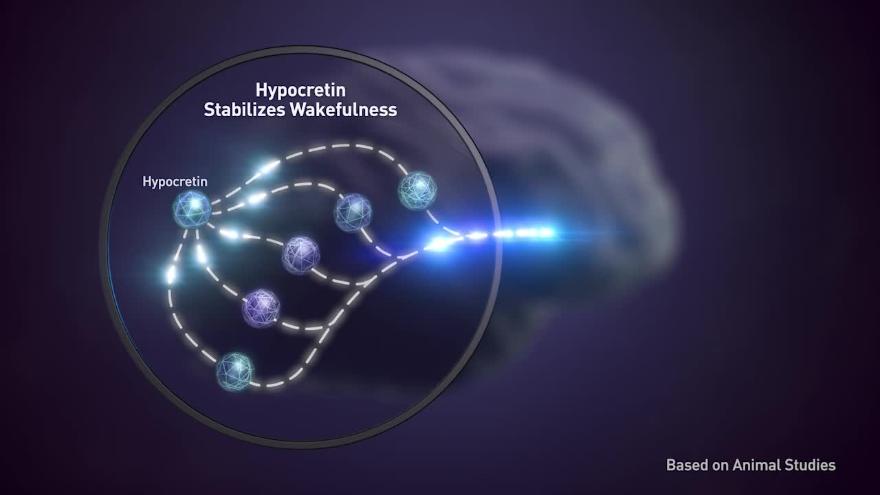
Interconnected wake-promoting neurons activate cortical and subcortical arousal regions and inhibit neurons primarily responsible for promoting rapid eye-movement (REM) sleep and non-REM (NREM) sleep.1,2 The neuropeptide hypocretin (or orexin) activates these wake-promoting neurons to help maintain wakefulness and muscle tone and inhibit REM sleep during the day.1,7
Narcolepsy: A Deeper Look
Narcolepsy type 1* (narcolepsy with cataplexy)
Narcolepsy type 1 is thought to be due to the permanent loss of hypocretin neurons. Patients with narcolepsy type 1 have low or undetectable levels of cerebrospinal fluid (CSF) hypocretin-1.3,†
Based on animal models, loss of hypocretin neurons is thought to lead to inconsistent signaling of wake-promoting neurons responsible for maintaining wakefulness and muscle tone and inhibit NREM and REM-sleep promoting neurons (eg, dopaminergic, noradrenergic, serotonergic neurons).1,7,‡
- Wake-promoting neurons fail to activate cortical and subcortical arousal regions and fail to inhibit sleep-promoting neurons (ie, GABAergic neurons), resulting in excessive daytime sleepiness.7
- Certain wake-promoting neurons that also suppress REM signaling fail to inhibit REM-promoting neurons, resulting in cataplexy and other abnormal manifestations of REM sleep such as hypnagogic/hypnopompic hallucinations and sleep paralysis.2,7
- Disruption of mutually inhibitory sleep-wake circuits may also lead to unwanted transitions from sleep to wakefulness and to associated sleep disruption.2,8
Narcolepsy type 2 (narcolepsy without cataplexy)
Narcolepsy type 2 is likely a heterogeneous disorder.3 In patients with narcolepsy type 2, cataplexy is not present, and CSF hypocretin-1 levels are usually normal or unknown.3 One quarter to one third of patients diagnosed with narcolepsy type 2 may actually have hypocretin deficiency, which would classify them as narcolepsy type 1 if levels were known, and about 8% may have intermediate levels of CSF hypocretin-1.3,9 These patients are more likely to develop cataplexy over time than those with normal hypocretin levels.9 The exact cause of narcolepsy type 2 is unknown.3
*Not all patients with narcolepsy type 1 experience all 5 symptoms.3,10
†CSF hypocretin-1 levels typically are not obtained in clinical practice.
‡Based on animal models. Other neuronal systems are also thought to be involved.1,7
- España RA, Scammell TE. Sleep neurobiology from a clinical perspective. Sleep. 2011;34(7):845-858.
- Scammell TE. The neurobiology, diagnosis, and treatment of narcolepsy. Ann Neurol. 2003;53(2):154-166.
- American Academy of Sleep Medicine. Central disorders of hypersomnolence. In: The International Classification of Sleep Disorders – Third Edition (ICSD-3) Online Version. Darien, IL: American Academy of Sleep Medicine; 2014.
- McAlpine CS, Kiss MG, Rattik S, et al. Sleep modulates haematopoiesis and protects against atherosclerosis. Nature. 2019;566(7744):383-387.
- Dauvilliers Y, Jaussent I, Krams B, et al. Non-dipping blood pressure profile in narcolepsy with cataplexy. PLoS One. 2012;7(6):e38977.
- Grimaldi D, Calandra-Buonaura G, Provini F, et al. Abnormal sleep-cardiovascular system interaction in narcolepsy with cataplexy: effects of hypocretin deficiency in humans. Sleep. 2012:35(4):519-528.
- Scammell TE. Narcolepsy. N Engl J Med. 2015;373(27):2654-2662.
- Alakuijala A, Sarkanen T, Partinen M. Hypocretin-1 levels associate with fragmented sleep in patients with narcolepsy type 1. Sleep. 2016;39(5):1047-1050.
- Andlauer O, Moore H 4th, Hong SC, et al. Predictors of hypocretin (orexin) deficiency in narcolepsy without cataplexy. Sleep. 2012;35(9):1247-1255F.
- Ahmed I, Thorpy M. Clinical features, diagnosis and treatment of narcolepsy. Clin Chest Med. 2010;31(2):371-381.